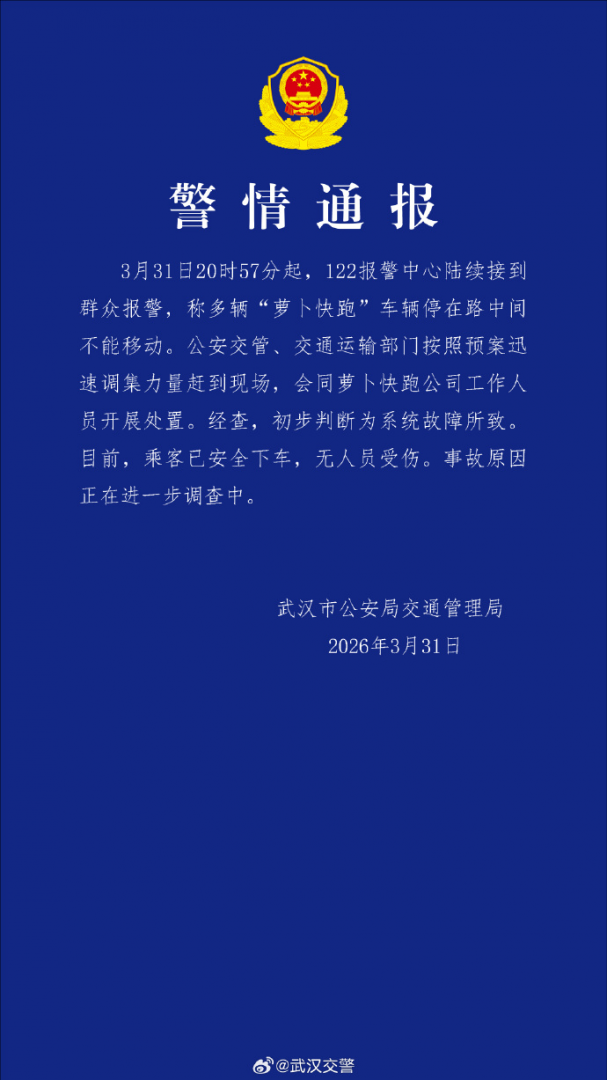
On Tuesday, the Wuhan Municipal Public Security Bureau’s Traffic Management Bureau issued a police report stating that beginning at 20:57 on March 31, multiple Apollo Go autonomous taxis suddenly came to a halt on major roads and elevated expressways in Wuhan, causing widespread traffic congestion.
Fortunately, no injuries or fatalities were reported. A preliminary investigation indicates that the incident was caused by a system malfunction.

According to on-site witnesses and passenger reports, when the malfunction occurred, nearly dozens of Apollo Go vehicles came to a complete standstill in the middle of the road. Some vehicles occupied fast lanes or stopped in the center of elevated roads, with hazard lights flashing but unable to move.
Several passengers were trapped inside the vehicles, with the longest wait time reaching nearly two hours. During this period, the in-car SOS buttons failed, customer service hotlines were busy, and some passengers had to call the police for help. The stalled vehicles led to multiple rear-end collisions, further worsening traffic conditions.
Following the incident, Wuhan’s traffic police and transportation authorities quickly activated emergency response measures, dispatching officers and rescue teams to the scene.
Together with Apollo Go staff, they evacuated passengers vehicle by vehicle and towed away the malfunctioning cars. By the early hours of April 1, all stranded passengers had been safely evacuated, and traffic order was gradually restored.

Apollo Go, an autonomous ride-hailing service platform under Baidu, operates based on Level 4 (L4) autonomous driving technology and has previously been commercially deployed in cities including Wuhan. This system failure has exposed potential safety risks in the large-scale operation of autonomous driving technology.
Industry analysts suggest that the malfunction may have been triggered by abnormalities in cloud communication or vulnerabilities in system algorithms, which caused the vehicles to activate a “safe stop” mechanism. However, such a mechanism may not have adequately accounted for the impact of large-scale failures on public traffic.

The exact cause of the incident is still under further investigation. Apollo Go has announced a citywide suspension of operations in Wuhan and is gradually resuming services, but has not provided detailed explanations regarding the technical failure.
The incident has once again raised public concerns over the safety of autonomous driving. Experts have called on the industry to strengthen system redundancy design, improve emergency response mechanisms, and enhance regulatory frameworks for incident reporting and accountability, in order to ensure a balanced development between technological deployment and public safety.